Introduction#
TTim is a Python package for the modeling of transient multi-layer groundwater flow with analytic elements.
The head, flow, and leakage between aquifer layers may be computed analytically at any point in the aquifer system and at any time.
Tutorials
Tutorials and how-to guides for getting started with TTim.
Concepts
TTim basic concepts and elements explained.
Examples
TTim example notebooks.
Pumping tests
TTim pumping test benchmark notebooks.
Benchmarks
Comparing TTim to known solutions.
Code reference
TTim code reference.
Quick Example#
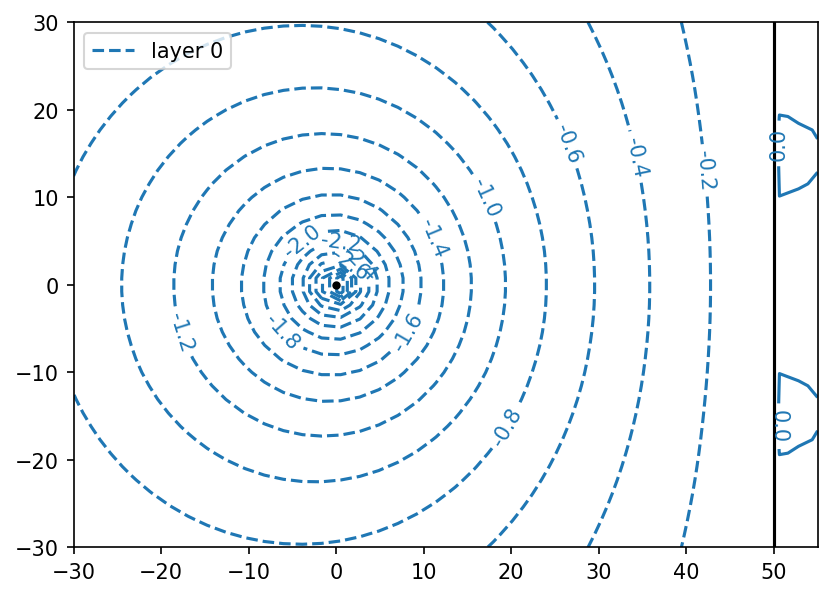
In this example a well is modelled near a river in a single aquifer.
# Import python packages
import numpy as np
import ttim

# Create model
ml = ttim.ModelMaq(kaq=10, z=[20, 0], Saq=[0.1], phreatictop=True, tmin=1e-3, tmax=100)

# Add a river with a fixed water level
yls = np.arange(-100.0, 101, 20)
xls = 50.0 * np.ones_like(yls)
river = ttim.HeadLineSinkString(ml, xy=list(zip(xls, yls)), tsandh='fixed')

# Add a well
well = ttim.Well(ml, 0.0, 0.0, rw=0.3, tsandQ=[(0, 1000)])

# Solve model
ml.solve()

# Plot head contours at t=2 days
ml.plots.contour(win=[-30, 55, -30, 30], ngr=40, t=2, labels=True, decimals=1)
In this example a well is modelled near a river in a single aquifer.
Approximations#
The Dupuit approximation is applied to aquifer layers, while flow in leaky layers is approximated as vertical.